
Databricks Data Engineer Professional Exam — Week 1: How to Think Like a Platform Engineer
Week 1: Exam Anatomy, Foundations, and a Deep Skill Gap Audit

Most experienced data engineers struggle with the Databricks Data Engineer Professional Certification mainly because they carry mental models from older systems—Hive, EMR, Glue, custom Spark clusters—that no longer align with how Databricks expects production data platforms to be designed and operated. The exam mainly focus on testing engineering judgment under constraint.
Week 1 is therefore is all about resetting how you think about data systems—so every decision you make in later weeks aligns with the exam’s underlying logic.
This post does three things:
Clarifies what the Professional exam is actually evaluating
Re-anchors core Databricks architectural assumptions
Walks through a skill gap audit, with explanations and exam-style reasoning
If this feels longer than a typical post, that is intentional.
This is the foundation the rest of the series depends on.
This post is accompanied by a small set of Databricks notebooks that surface the behaviors discussed below—schema drift, write amplification, MERGE costs, and operational failure modes.
They are optional, but strongly recommended if you are preparing seriously for the exam.
→ GitHub repo: Databricks Data Engineer Professional – Study Guide (Week 1)
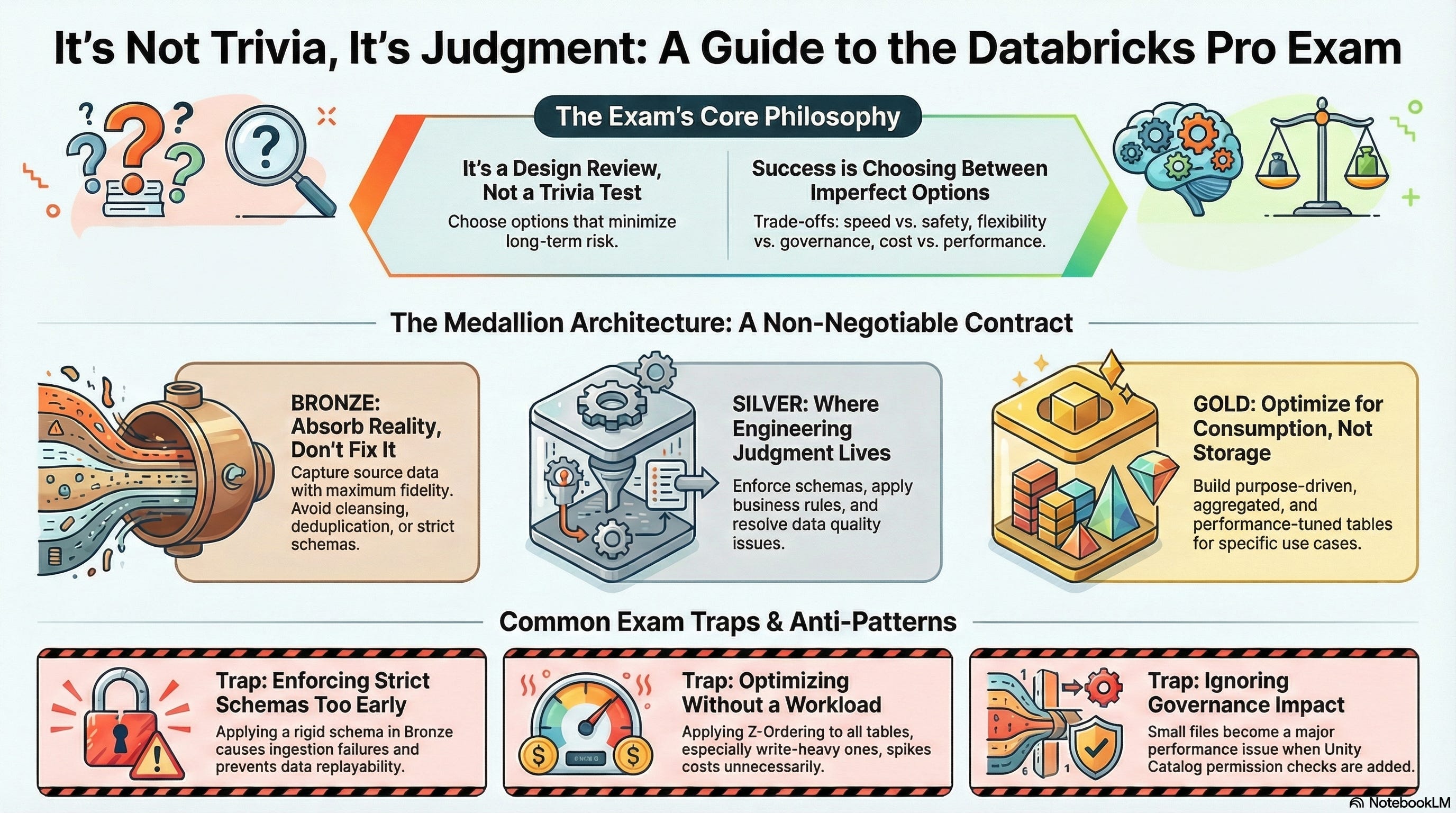
1. What the Databricks Professional Exam Is Really Testing
On the surface, the exam looks manageable:
59 questions
120 minutes
~70% passing score
In practice, most questions are situational, not factual.
You are repeatedly asked to choose between imperfect options:
Faster now vs safer later
Flexible ingestion vs governed consumption
Cheap execution vs predictable performance
Nearly every question reduces to a single idea:
Given real production constraints, which option minimizes long-term risk?
The exam assumes you already know:
Basic PySpark and SQL
What Delta tables are
How distributed execution works at a high level
What it evaluates is whether you understand:
How systems degrade over time
Where optimizations backfire
How governance, cost, and reliability interact
If you approach this exam like a trivia test, it feels inconsistent.
If you approach it like a design review, it becomes predictable.
2. The Medallion Architecture Is a Contract, Not a Pattern
Databricks treats Medallion Architecture as a non-negotiable contract.
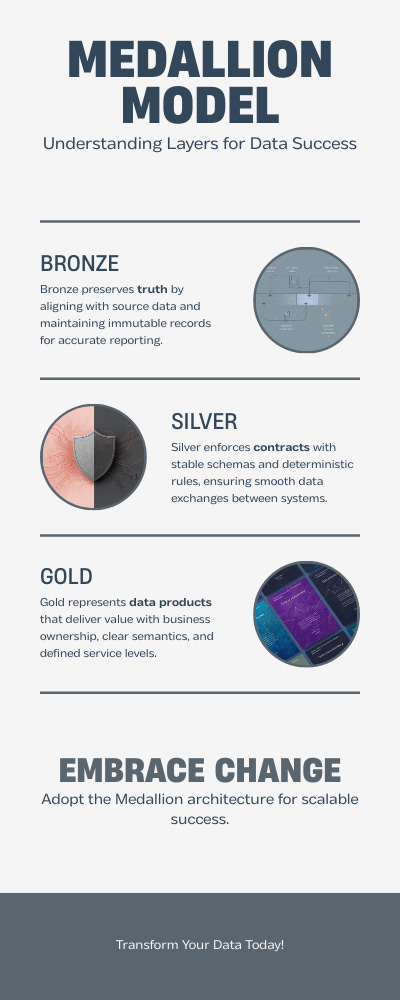
The exam expects you to reason within this contract, not around it.
Bronze: Absorb Reality, Don’t Fix It
Bronze exists to capture source data with maximum fidelity and minimum friction.
Key characteristics:
Append-first
Minimal transformations
Schema drift tolerated
Replayable by design
What the exam tests here is not how to ingest—but what not to do:
Do not aggressively cleanse
Do not deduplicate
Do not enforce rigid schemas
If Bronze is mutable or overly curated, you lose replayability.
When replayability is gone, debugging and recovery become guesswork.
The exam consistently penalizes “helpful” transformations at this layer.
Silver: Where Engineering Judgment Lives
Silver is where intent enters the system.
This is where you:
Enforce schemas
Apply business rules
Resolve duplicates and late arrivals
Most Professional-level questions live here, because Silver decisions propagate quietly and expensively.
Silver answers questions like:
What is a valid record?
Which fields are authoritative?
How do we handle late or conflicting updates?
The exam often frames Silver issues as pipeline bugs—but they are usually modeling mistakes.
Gold: Optimize for Consumption, Not Storage
Gold is not “better Silver.”
Gold is purpose-built.
Characteristics:
Aggregated
Opinionated
Performance-tuned
A common exam trap:
Optimizing Bronze or Silver too early
Never optimizing Gold at all
The exam rewards placement discipline—knowing where optimization belongs.
3. Ingestion: Low Weight, High Impact
Ingestion has lower numerical weight, but it defines the boundary conditions for everything downstream.
Auto Loader vs Batch Is About Risk, Not Convenience
The exam is not asking:
Which is easier to set up?
It is asking:
Which option contains change most safely?
Auto Loader matters because it:
Decouples arrival from processing
Enables incrementalism
Supports safe reprocessing
Batch ingestion is valid—but only when change is bounded and predictable.
Schema Inference Is a Temporary Crutch
Schema inference is acceptable:
Early
In Bronze
With observability
It becomes dangerous when:
Schemas evolve frequently
Downstream tables assume stability
The exam frequently tests where schema enforcement belongs—not whether it exists.
Checkpointing Is a Design Decision
Checkpointing determines:
Replayability
Recovery strategy
Late data handling
If you cannot explain why a checkpoint exists, the exam treats it as accidental design.
4. Deep Skill Gap Audit
A. Architecture & Conceptual Judgment
Where should schema enforcement happen—and why?
Bronze should absorb change.
Silver should enforce contracts.
Gold should assume stability.
Enforcing schemas too early increases fragility.
Enforcing them too late increases risk.
When does Z-Ordering increase cost?
When tables are small, frequently written, or accessed unpredictably.
Optimization is workload-dependent.
The exam penalizes “always optimize” thinking.
What breaks first when Bronze data is mutable?
Not dashboards—trust.
Mutability destroys replayability, auditability, and confidence.
B. Delta Lake Reasoning
What happens during a MERGE?
Files are scanned, matched, and rewritten.
MERGE is powerful—but expensive.
Partitioning and file layout matter more than syntax.
When is schema evolution dangerous?
When semantics change silently or downstream assumptions are implicit.
Automatic evolution without contracts is an exam red flag.
Why are small files a governance problem?
They inflate metadata, slow permission checks, and increase operational fragility.
Performance and governance are not independent concerns.
C. Operational Judgment
When should you avoid caching?
When data is accessed once, memory is constrained, or streaming workloads are present.
Caching competes with execution memory.
What signals over-provisioning?
Low CPU utilization, idle executors, flat latency gains with rising cost.
The exam expects metric-driven reasoning.
When is a “successful” job a failure?
When it violates SLAs or produces incorrect results.
Exit code zero is not success.
D. Governance & Unity Catalog Intuition
Why does Unity Catalog change schema design?
Because permissions, ownership, and sharing become structural.
Unity Catalog rewards fewer schemas with clear ownership boundaries.
5. Exam-Style Scenario Questions
The following scenarios mirror how the Professional exam frames decisions.
Scenario 1: Strict Schema at Ingestion
Auto Loader ingests JSON with occasional new fields.
An engineer enforces a strict schema in Bronze.
Most likely outcome?
→ Increased ingestion failures and loss of replayability.
Bronze should absorb variability, not reject it.
Scenario 2: Z-Ordering Everything
Z-Ordering is applied to all tables, including Bronze.
Why did costs spike?
→ Z-Ordering rewrites files and is expensive on write-heavy workloads.
Optimization without workload stability backfires.
Scenario 3: MERGE Performance Degrades Over Time
Hourly MERGE jobs slow down despite stable data volume.
Root cause?
→ Increasing file rewrites due to poor layout and partitioning.
MERGE cost scales with files touched.
Scenario 4: Small Files Meet Unity Catalog
Queries were fast until governance was added.
Why did latency increase?
→ Permission checks scale with metadata volume.
Caching masked the problem until governance exposed it.
Scenario 5: Caching as Default
Caching all tables causes OOMs and unstable streaming jobs.
Why?
→ Cached data competes with execution and state memory.
Memory is a shared resource.
Scenario 6: “Successful” ETL Job
Jobs succeed, but dashboards are inconsistent.
Why is this still a failure?
→ Success includes correctness and timeliness, not just completion.
Scenario 7: Unity Catalog Migration Pain
Too many schemas lead to permission sprawl.
What went wrong?
→ Schemas should represent ownership boundaries.
Governance works best when design is intentional.
6. What to Set Up This Week
Keep it minimal:
One Databricks workspace
One Delta location
One notebook for experiments
Complex environments hide conceptual gaps.
What’s Next: Week 2
Week 2 dives into the highest-weighted exam area:
PySpark & SQL transformations
MERGE patterns
SCD Type 1 vs Type 2 decisions
Schema evolution trade-offs
This is where many experienced engineers discover outdated instincts.
Final Thought
This exam is not testing whether you can build pipelines.
It is testing whether you understand why pipelines fail.
Everything from here forward builds on that premise.
Next: Week 2 — ETL Mastery with PySpark and Delta Lake.
If any section above felt uncomfortable, that is exactly where your highest exam leverage lies.